Simple rug sizing rules, measuring tips, and placement ideas for living rooms, bedrooms, dining spaces, and entryways. Plus the most common mistakes to avoid.
home decor / design / interior decoration
What Size Rug Do You Need for a Sectional Sofa?

Maya Thorne
Maya Thorne is an interior stylist and the creative voice behind Homoraa. With over a decade of experience blending vintage finds with modern aesthetics, she helps readers transform ordinary spaces into personalized sanctuaries. When she is not rearranging her living room, she can usually be found hunting for unique ceramics and textiles at local flea markets.
Created: September 29, 2026
Updated: September 29, 2026
If your sectional feels like it is floating, cramped, or awkwardly cropped, the rug is usually the culprit. A well-sized rug makes a sectional look intentional, gives the coffee table a “home,” and creates that calm, pulled-together feeling even if the rest of the room is still a work in progress.
Here is the simplest way to get it right: decide which rug rule you are using (front legs on, all legs on, or full coverage), then measure the seating area you want the rug to define. From there, you match to the closest standard rug size.
The three rug rules
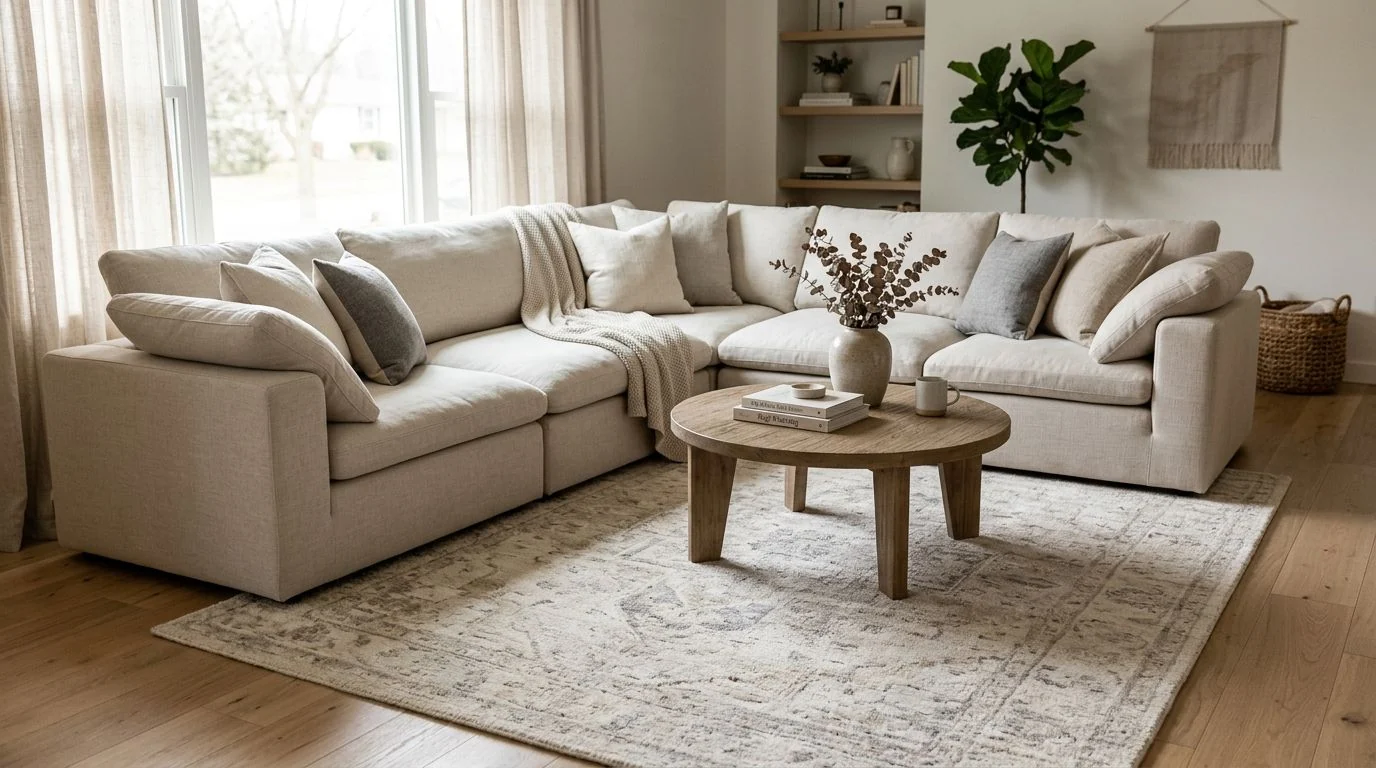
1) Front legs on (the most flexible)
Place the rug so the front legs of the sectional sit on it, with the rug extending about 8 to 12 inches past the sofa on the exposed sides (as space allows). This anchors the seating area without needing a massive rug.
- Best for: small to medium rooms, rentals, and open-plan spaces where you want definition without swallowing the floor.
- Goal: coffee table fully on the rug, plus a comfortable border around it.
2) All legs on (the polished look)
Every piece in the seating group sits fully on the rug, including the sectional and any chairs. This feels generous and finished, but it requires more square footage.
- Best for: medium to large rooms where you can leave a border of bare floor between the rug edge and walls. As a guideline, aim for 6 to 18 inches, and go narrower if doors, vents, or walkways need the space.
- Goal: one unified island that visually contains the whole conversation area.
3) Full coverage (room-foundation vibe)
The rug spans most of the room, sometimes reaching close to media consoles and sideboards. This is the cozy, hospitality-inspired approach.
- Best for: large living rooms and open-plan great rooms where you need the seating zone to feel grounded.
- Goal: the rug reads as the room’s foundation, not a small mat under the coffee table.
How to measure fast
Grab a tape measure and answer these two questions:
- How wide is the seating zone? Measure across the longest run of the sectional. Then plan on 8 to 12 inches of rug overhang per exposed side (meaning the sides not pushed against a wall, built-in, or console). That is 16 to 24 inches total if both sides are exposed.
- How deep is the seating zone? Measure from the wall behind the sectional (or the back of the sofa) to where you want the rug to end in front. As a guideline, many rooms look best when the rug extends 6 to 12 inches past the coffee table, and 12 to 18 inches if you have the space. In tighter rooms, prioritize walkways and door swings over extra border.
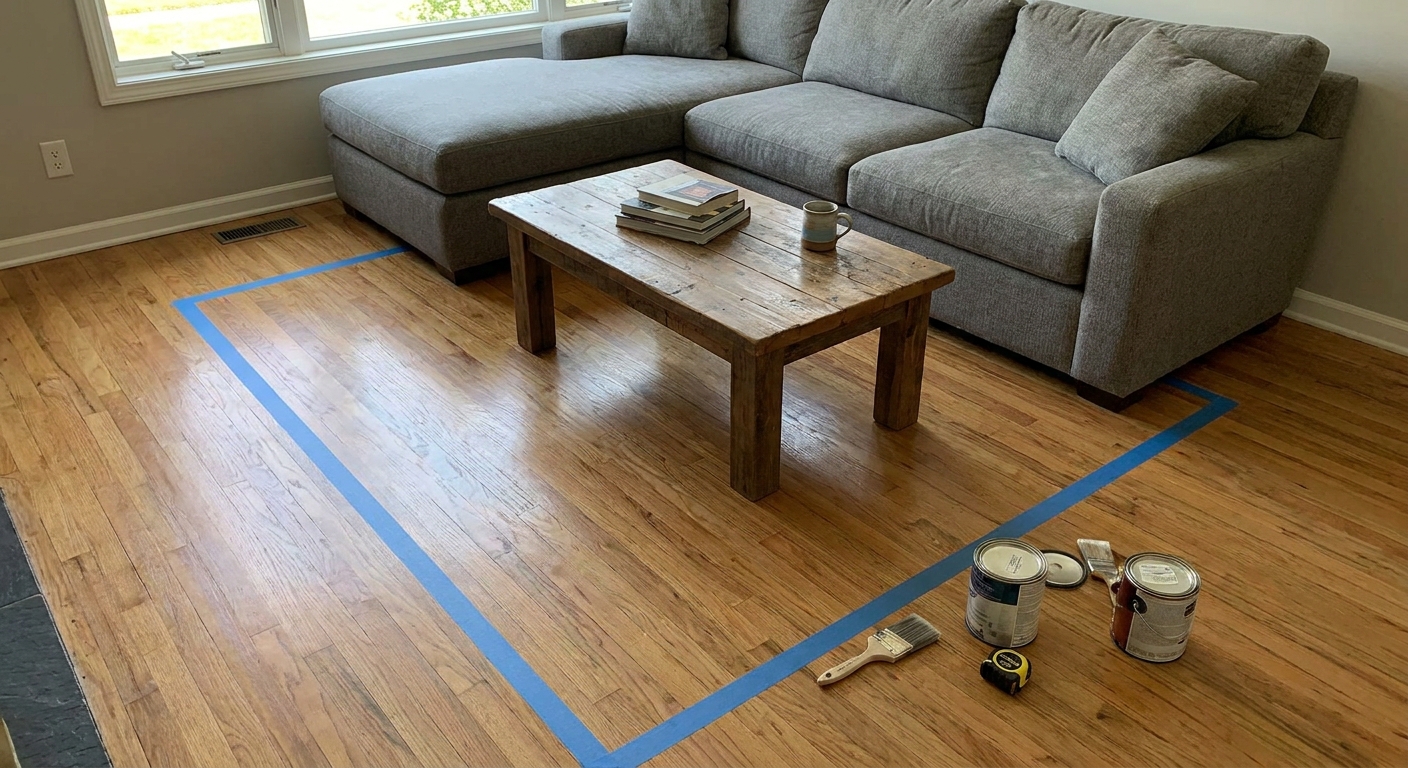
Maya tip: Before you buy, outline the rug with painter’s tape. It is the quickest way to see if the room will feel tight or just right. (Maya is an interior designer who swears by this trick.)
Quick cheat sheet
- 7'6" x 9'6" (or 8' x 10'): great for front legs on in many apartments
- 9' x 12': the sweet spot for medium rooms and many L-shaped sectionals
- 10' x 14': ideal for large rooms, U-shaped sectionals, or all legs on layouts
- 12' x 15' (and larger): full-coverage look in expansive open plans
If you are between sizes, I almost always vote up, as long as you can still move through the room comfortably. A too-small rug makes a sectional look oversized and slightly accidental.
Small rooms
Small rooms need the rug to anchor the seating area without blocking walkways. For most compact layouts, front legs on is your friend.
Layout rules
- Aim for a clear path of about 30 to 36 inches where people walk most.
- Make sure the coffee table sits fully on the rug.
- If the room is tight, let the rug sit closer to the sectional rather than pushing it toward the TV console.
- Keep an eye on door swing clearance near entries. If a door catches on a thick edge, size down, rotate the rug, or choose a lower pile.
- Avoid an in-between stop. Either connect it to the sectional (front legs on) or commit to a different layout that clearly relates to the coffee table.
Best sizes
- 5' x 8': only for very small sectionals or chaise-style sofas, and usually looks better in a snug den than a main living room
- 7'6" x 9'6" or 8' x 10': most common win for apartment sectionals
Quick example
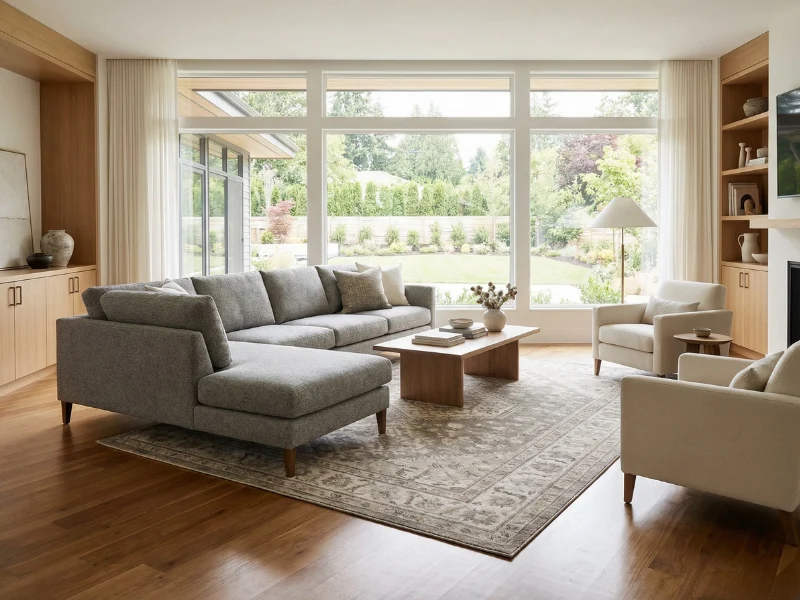
Say your sectional’s long side is 96 inches (8 feet). If you want the rug to extend about 12 inches beyond the open side, you are at roughly 108 inches wide. That points you toward an 8' x 10' (96" x 120") so the seating zone feels anchored without swallowing the room.
Medium rooms
In a medium living room, you have enough space to choose between front legs on and all legs on depending on your vibe. If you want the room to feel calmer instantly, go bigger here.
Layout rules
- Aim for the rug to extend about 8 to 12 inches past the sectional on exposed sides (give or take based on doors and traffic paths).
- When possible, leave about 6 to 24 inches of floor between the rug edge and the walls. Narrow borders can look great in tighter rooms, and wider borders can feel airier in big ones.
- If you have an accent chair, try to get both front legs on the rug too.
Best sizes
- 8' x 10': works if your sectional is on the smaller side or the room has lots of doors
- 9' x 12': the most reliable choice for L-shaped sectionals in average living rooms
Quick example
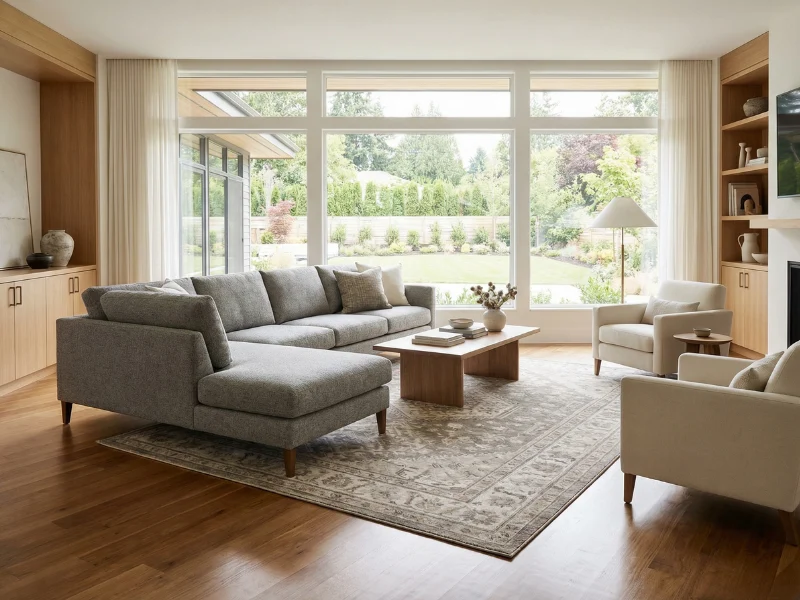
Your sectional footprint (the area it occupies) is about 10 feet wide by 8 feet deep. You want the rug to reach under the front legs and give the coffee table breathing room. A 9' x 12' rug (108" x 144") typically covers that seating zone comfortably, especially when the 12-foot side runs along the sectional’s longest run.
Large rooms
Large rooms can handle a generous rug, and they usually need one. Without it, a sectional can feel like it is camping in the middle of an empty field.
Layout rules
- Choose all legs on if you want the most finished look.
- Make sure the rug extends beyond the sectional edges by about 12 to 24 inches on open sides, as space allows.
- If you have side tables, it is fine if they sit half on, half off, but avoid a look where every table is stranded off the rug.
Best sizes
- 9' x 12': a common starting point for larger rooms with sectionals
- 10' x 14': best for big L-shaped sectionals, U-shaped sectionals, or when you have extra seating
- 12' x 15': when you want the rug to read like the room’s base layer
Quick example
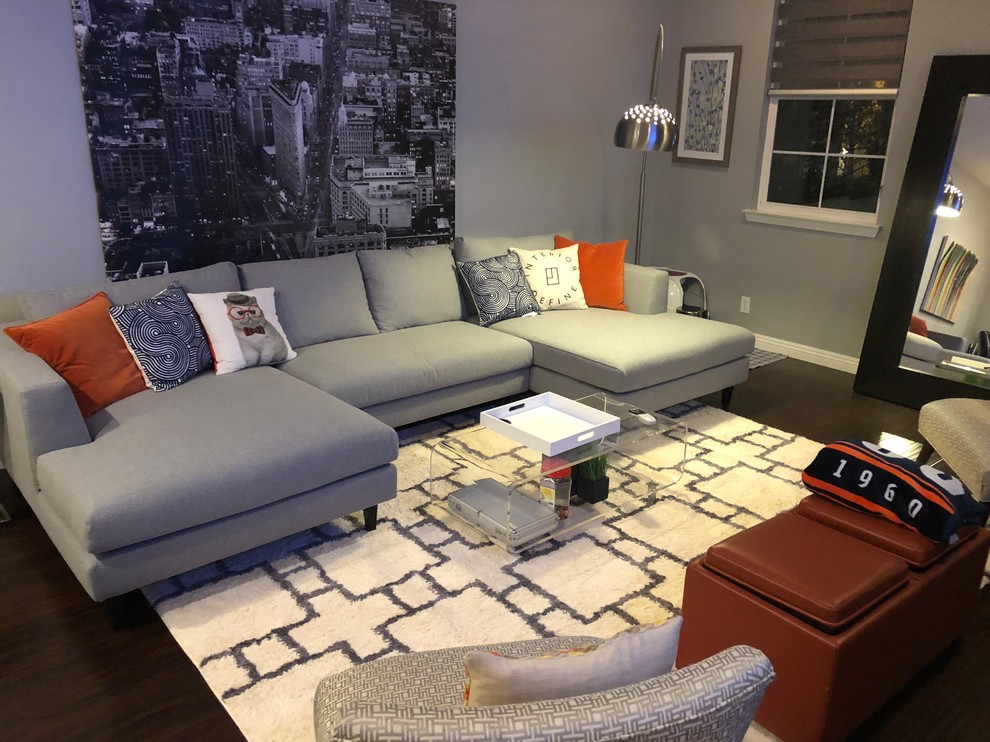
You have a large sectional that measures 11 feet on the long side and the coffee table sits about 14 to 18 inches away from the sofa (a comfortable range for most layouts). To keep everything grounded, a 10' x 14' rug often gives you enough width to extend past the sectional and enough depth to hold the coffee table plus a comfortable border.
Open-plan spaces
In open-plan living rooms, rugs are your invisible walls. The goal is to give the sectional its own “room” while still letting the space flow.
Keep it calm
- Match the rug to the seating group, not the whole floor plan. Your living zone rug should neatly contain the sectional and coffee table.
- Keep consistent rug logic. If the dining area also has a rug, aim for similar visual weight (not necessarily matching, just balanced).
- Watch the walkway lines. If the main traffic path runs between kitchen and living area, keep the rug edge out of the pinch point so people are not constantly stepping on and off a narrow strip.
What sizes work
- 9' x 12': for many open-plan living zones with an L-shaped sectional
- 10' x 14' or larger: if your sectional is big or you want the living zone to feel extra anchored
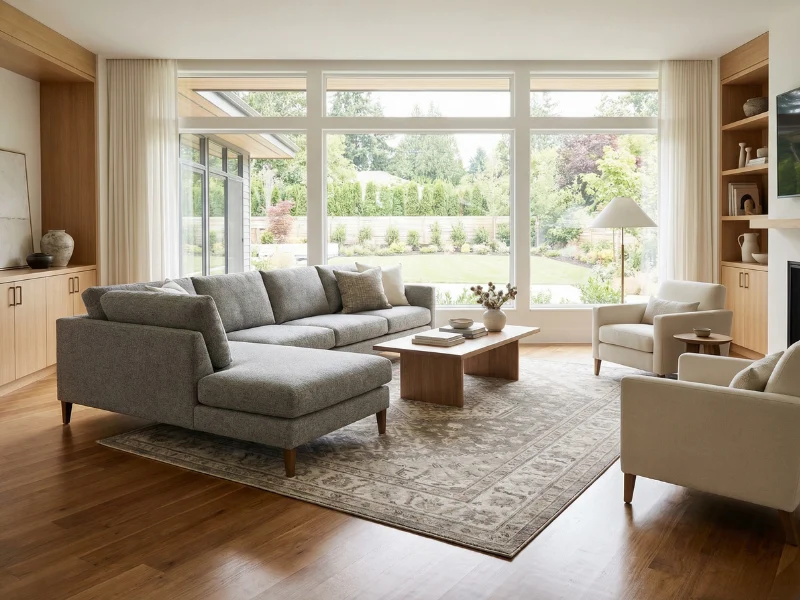
Common layouts
L-shaped sectional (chaise on one end)
- Small room: 8' x 10' with front legs on
- Medium room: 9' x 12' for a more balanced border
- Large room: 10' x 14' if you want all legs on or you have extra chairs
U-shaped sectional
- Medium room: 9' x 12' can work if the sectional is compact and the coffee table is modest
- Large room: 10' x 14' is often the starting point, with 12' x 15' for full coverage
Sectional with a separate ottoman
Treat the ottoman like your coffee table. If it is part of the lounging zone, it should sit fully on the rug, with a little border around it so it does not look jammed in.
Round or square rugs
If your sectional is paired with curved chairs or a round coffee table, a round or square rug can soften all those right angles. One note: round rugs can read smaller than you expect, so size up enough that the coffee table sits fully on the rug and the sectional can still get its front legs on comfortably.
Same rules apply: get the front legs on, and make sure the table is fully on the rug.
Finishing details
Mind the rug orientation
Run the rug’s longer side along the sectional’s longer run whenever possible. It makes the layout feel calmer and more proportional.
Leave breathing room
A rug that stops exactly at the sectional edge tends to look undersized. Aim for an 8 to 12 inch overhang on exposed sides when you can.
Get coffee table spacing right
Aim for about 14 to 18 inches between the sectional and coffee table. It is close enough to reach your drink, but not so close you feel wedged in.
Choose a practical pile
Sectionals are for real life. A low-pile wool, a durable flatweave, or a high-quality washable rug keeps furniture stable and makes cleaning less of a mood.
Use the right rug pad
A rug pad helps prevent shifting, protects floors, and makes even a budget rug feel thicker underfoot. On hardwood or tile, go for a grippy non-slip pad. Over carpet, use a pad made for carpet (typically a firmer felt-only pad, and avoid rubber that can grab and ripple). When in doubt, check the rug and carpet manufacturer guidance.
When standard sizes do not fit
If you are in an in-between room (or you are working around doors and built-ins), you have options: consider custom sizing, bound broadloom, or layering a patterned rug over a larger natural-fiber base for that oversized look without the custom price tag.
FAQ
Should the rug go under the sectional?
Yes, at least under the front legs. It is the easiest way to make the seating area feel anchored. All legs on is even better if your room and budget can handle the size.
Is an 8' x 10' rug big enough for a sectional?
Often, yes, especially in apartments and small-to-medium rooms. It works best when the sectional’s front legs sit on the rug and the coffee table is fully on the rug.
Is a 9' x 12' rug too big?
Not if it fits your seating zone and you still have comfortable walkways and door clearance. In many rooms, 9' x 12' is the size that finally makes the sectional look proportional.
What if I am between sizes?
Tape it out on the floor first. If both sizes technically fit, go larger if it still leaves a clear walking path. A slightly oversized rug reads intentional. A too-small rug reads accidental.
Fast decision method
If you want to choose in under two minutes, do this:
- Pick your rule: front legs on for most homes, all legs on if your room is generous.
- Measure the seating zone: sectional width plus 8 to 12 inches per exposed side, then depth that includes the coffee table plus some breathing room.
- Match to a standard size: 8' x 10' for compact zones, 9' x 12' for most medium rooms, 10' x 14' for large conversation areas.
Your sectional should feel like it belongs to the rug, not like it is trying to avoid it.